
Book Overview | Built to Think — Leanne Terrace
MEDIA CENTER / BOOK OVERVIEW

Book Overview

Built to Think

Build Teams That Solve Problems, Without Waiting for Permission in the Age of AI
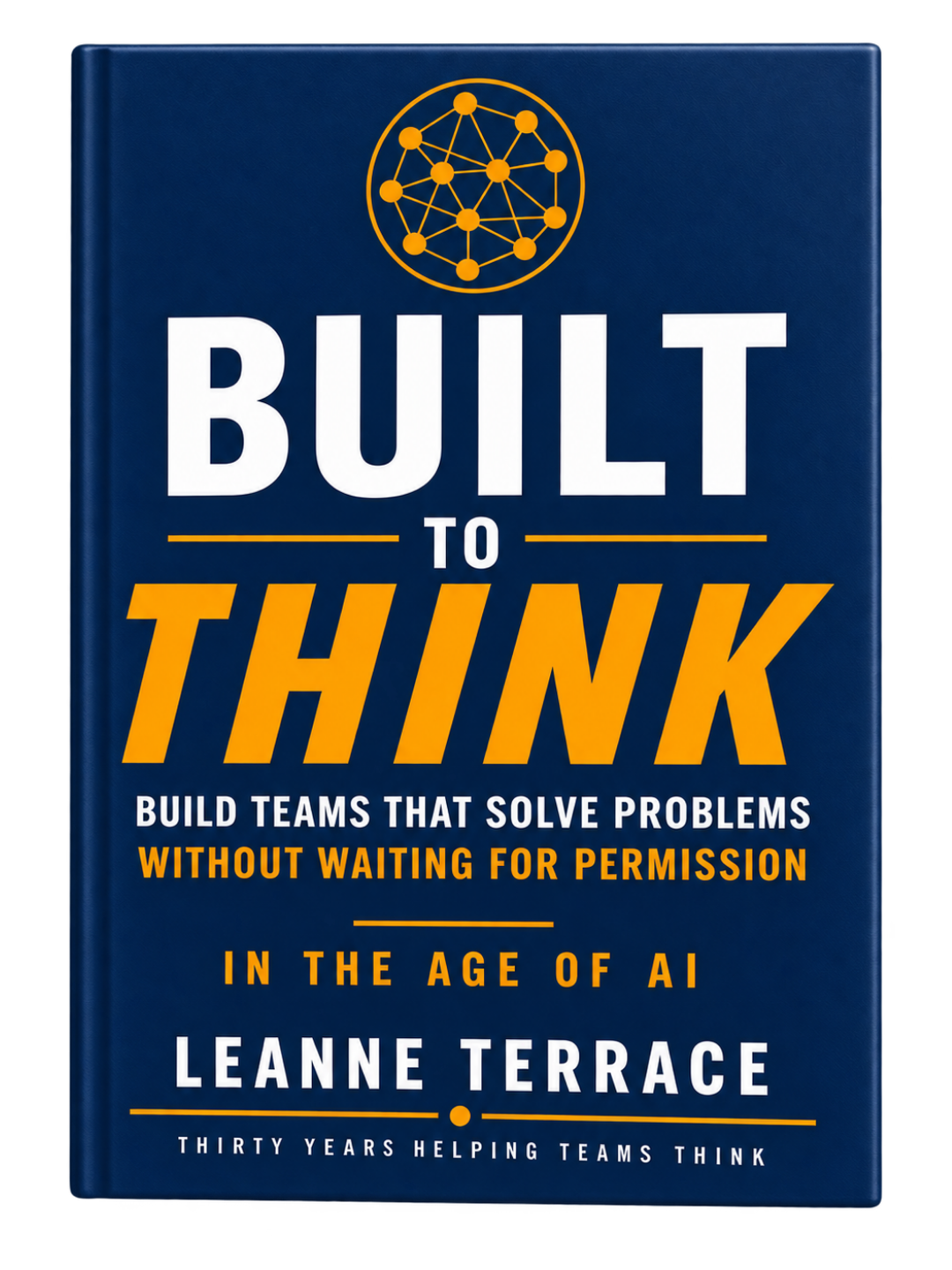
Built to Think book cover by Leanne Terrace

Book Overview

A practical leadership book about helping teams develop the structures, agreement, and disciplines to solve problems without routing every important decision through the leader.

As organizations grow, their most capable leaders frequently become their greatest constraint. Decisions accumulate at the top, employees wait for direction, meetings multiply, and founders or executives find themselves solving problems their teams should increasingly be equipped to handle.

In Built to Think, Canadian executive advisor and AI integration strategist Leanne Terrace argues that this pattern is not simply a failure of delegation, trust or employee initiative. It is a structural problem that develops predictably when an organization grows without deliberately building the systems through which people can think, decide and act together.

Drawing on three decades of experience in Fortune 500 companies, founder-led businesses, nonprofits, startups and international operations - including leading through a civil war in West Africa - Terrace examines why intelligent, committed teams can gradually stop making decisions independently without next level input. She then presents a practical framework for distributing problem-solving capacity without abandoning accountability or leaving employees unclear about their authority.

The book explores how leaders can establish psychological safety, clarify decision rights, use differences constructively, improve implementation and turn organizational learning into a repeatable operating discipline. Its seven disciplines of thinking together and SIGNAL operating system are designed to help organizations move from dependence on individual problem-solvers toward shared, sustainable, and growing capability and capacity.

Terrace also challenges the assumption that artificial intelligence will help solve common challenges like bottlenecks in decision making, poor communication, lack of safety, or poor structure. Her central argument is that AI amplifies the human system into which it is introduced: it can accelerate a capable team, but it can also accelerate confusion, poor judgment and misalignment. Organizations must therefore strengthen how their people think together if they want AI to create lasting value.

MEDIA CENTER / BOOK OVERVIEW

Book Overview

Built to Think

Build Teams That Solve Problems, Without Waiting for Permission in the Age of AI

Built to Think book cover by Leanne Terrace

Book Overview

A practical leadership book about helping teams develop the structures, agreement, and disciplines to solve problems without routing every important decision through the leader.

As organizations grow, their most capable leaders frequently become their greatest constraint. Decisions accumulate at the top, employees wait for direction, meetings multiply, and founders or executives find themselves solving problems their teams should increasingly be equipped to handle.

In Built to Think, Canadian executive advisor and AI integration strategist Leanne Terrace argues that this pattern is not simply a failure of delegation, trust or employee initiative. It is a structural problem that develops predictably when an organization grows without deliberately building the systems through which people can think, decide and act together.

Drawing on three decades of experience in Fortune 500 companies, founder-led businesses, nonprofits, startups and international operations - including leading through a civil war in West Africa - Terrace examines why intelligent, committed teams can gradually stop making decisions independently without next level input. She then presents a practical framework for distributing problem-solving capacity without abandoning accountability or leaving employees unclear about their authority.

The book explores how leaders can establish psychological safety, clarify decision rights, use differences constructively, improve implementation and turn organizational learning into a repeatable operating discipline. Its seven disciplines of thinking together and SIGNAL operating system are designed to help organizations move from dependence on individual problem-solvers toward shared, sustainable, and growing capability and capacity.

Terrace also challenges the assumption that artificial intelligence will help solve common challenges like bottlenecks in decision making, poor communication, lack of safety, or poor structure. Her central argument is that AI amplifies the human system into which it is introduced: it can accelerate a capable team, but it can also accelerate confusion, poor judgment and misalignment. Organizations must therefore strengthen how their people think together if they want AI to create lasting value.